
In this article
False alarm reduction comes down to three things: fewer mistakes by the people who arm and disarm the system, equipment that fits the building, and a person or process that confirms an alarm before police are sent. The first is a training and routine problem, the second is a site-planning problem, and the third is where trained on-site and remote security staff earn their place. At GuardEX, we build security plans around each property’s specific risks and operations, and false alarms are one of the clearest places to see why that matters.
This guide is for New Jersey property managers, business owners, school administrators, HOA leaders, and warehouse, plant and construction-site operators who contract for security coverage. It separates general good practice from what New Jersey municipalities require.
Key Takeaways
- Most false alarms are preventable. Bellevue, Washington’s city guide attributes more than 80 percent of false alarms to user error, which means training and routines matter more than hardware.
- In New Jersey, alarm registration, fees and fines are set town by town. Check your municipality’s ordinance before you assume anything about your site.
- Verification before dispatch, through a call list, video or a person on site, is the most direct way to reduce unnecessary police responses.
- Measure progress with false alarms per alarm user or per site, tracked over time, not with a percentage alone.
What counts as a false alarm
A false alarm is an activation that brings a police response when no burglary or other crime occurred. Bellevue’s guide defines it as an activation caused by equipment failure, malfunction, improper installation, or negligence by the user, employees or agents, found by police to have no unauthorized entry behind it.
It is different from a nuisance alert that your monitoring provider resolves with a phone call. The costly kind is the one that sends a patrol car.
Why false alarms matter to a property operator
For the public, the problem is diverted resources. For you, it is fines, registration problems and, in the worst case, reduced police response.
The U.S. Department of Justice’s COPS Office guide reports that 94 to 98 percent of alarm calls are false, and that in 2002 police answered about 36 million activations at an estimated cost of $1.8 billion. These figures come from data collected between 1999 and 2004, so read them as a picture of scale rather than a current count. Locally, the pattern holds: the Walla Walla, Washington police department says 70 to 80 percent of its alarm requests are false and that it may stop responding to a location with excessive false alarms unless there is a separate sign of a crime in progress.
The same guide says commercial false-alarm rates may be up to three times residential rates. The reasons are practical: more people share arming and disarming duties, and commercial systems tend to be more complex. If you manage a warehouse, school, plant or multi-tenant building, you are in the higher-risk group for this problem, and also in the group that can do the most about it.
What actually triggers false alarms
The DOJ guide groups causes into three buckets: user error, faulty or poorly chosen equipment, and poor installation. Weather, monitoring-center mistakes and line errors add to the list.
On commercial sites, the Bellevue guide lists these common triggers:
- Doors or windows that are loose or not fully latched
- Cleaning crews, repair technicians and other visitors who do not know the code or the exit delay
- Banners, signs, plants or curtains moving in air drafts
- Stacked boxes that fall into a motion detector’s view
- Forklifts striking motion sensors or overhead door contacts
- Birds, pets and other animals
The Orange County, California Sheriff’s Office adds that commercial settings share conditions such as constant public access, shared buildings, frequent deliveries, opening and closing routines and janitorial service. Those descriptions fit New Jersey distribution centers, strip malls and office parks as well as they fit California.
A quick walk-through by property type
| Property | Typical trigger | First thing to check |
|---|---|---|
| Warehouse or 3PL facility | Forklift contact with sensors, overhead doors, birds in high bays | Detector placement and door contacts |
| School | Late-day events, custodial crews, fire pull stations | Who has codes, who arms last |
| Multi-tenant office | Tenants and cleaners arming each other’s zones | Code ownership and exit delay |
| Construction site | Changing layouts, equipment and trades moving through | Updating zones as the site changes |
| Gated community | Gate and amenity-building alarms, vendor access | Vendor access rules and call lists |
The table is general guidance drawn from the triggers above, applied to common property types. Your own site will have its own pattern, which is why the first step below is to find it.
A practical false alarm reduction routine
1. Find your pattern before you change anything
Pull every alarm event from the last 12 months from your monitoring provider and your own incident log. Sort them by time of day, zone, who armed or disarmed, and cause. Most sites find that a few zones or a few people account for most events.
Our security site assessment guide walks through how to review a property’s weak points, and a site-specific review is the starting point of every GuardEX security plan.
2. Train everyone who touches the system
The Orange County Sheriff’s Office says employee error is the number one cause of false alarms at opening and closing. Its recommendations include fully training new users, holding monthly refreshers, checking entry and exit delay times with the alarm company, and securing doors and windows before arming.
NESA, the national alarm industry association, adds that everyone with a key should be trained and that the alarm company should be told when pass codes, construction, displays or phone service change.
In practice:
- Give each person their own code and remove codes the day someone leaves.
- Tell your alarm provider about janitorial and contractor code changes.
- Put a short close-out checklist at the exit: doors latched, bays closed, motion areas clear, then arm.
Where a property has GuardEX officers on site, on-site officer training and clear reporting are part of how we hold service to account, so opening and closing events can be logged consistently instead of relying on memory.
3. Fit the equipment to the building
The OC Sheriff’s guide recommends moving items that shift within a motion detector’s view, placing detectors carefully in high-bay areas with overhead doors, vents and exhaust fans where birds can enter, and using wide-gap contacts on both sides of overhead doors. It also advises regular servicing and annual battery changes.
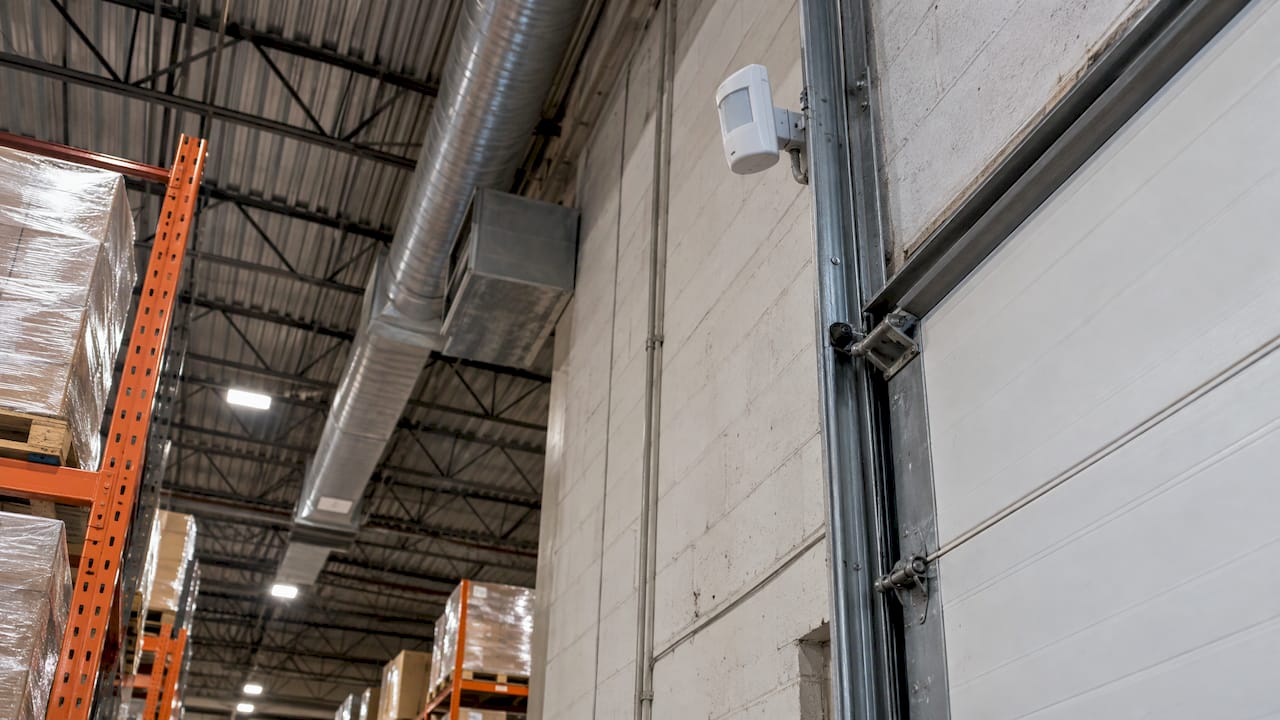
The alarm industry’s Guide to Alarm Equipment, from FARA and NESA, recommends cross-zoning: two devices must both trip before the alarm signals. It also suggests monitoring companies consider not dispatching on a single motion signal.
For a warehouse or plant, that usually means asking your installer to review detector height and aim after any racking or layout change. If your site’s video or access control needs planning or installation, we handle video security systems and access control systems as part of the same site plan.
4. Verify before police are dispatched
Verification is the step with the most direct effect on unnecessary responses. FARA and NESA describe Enhanced Call Verification: the monitoring operator tries a responsible party, then a second number, before requesting dispatch. They report it has proven to drastically reduce dispatch requests. Two-way voice and video can serve the same purpose.
To make verification work:
- Keep the call list current, with at least two reachable people for every site.
- Make sure someone on that list can reach the property quickly, day or night.
- Agree in writing which alarm types are verified and which, such as panic or duress, go straight to dispatch.
- Call the alarm company, not 911, to cancel an accidental activation. The Bellevue guide gives that instruction.
A person who can reach the site matters here. Our mobile patrol security and remote security monitoring services are designed to give a property a way to check an event on camera or in person, which gives your call list a stronger first step than a phone that rings unanswered at 2 a.m.
5. Use people and cameras for what each does well
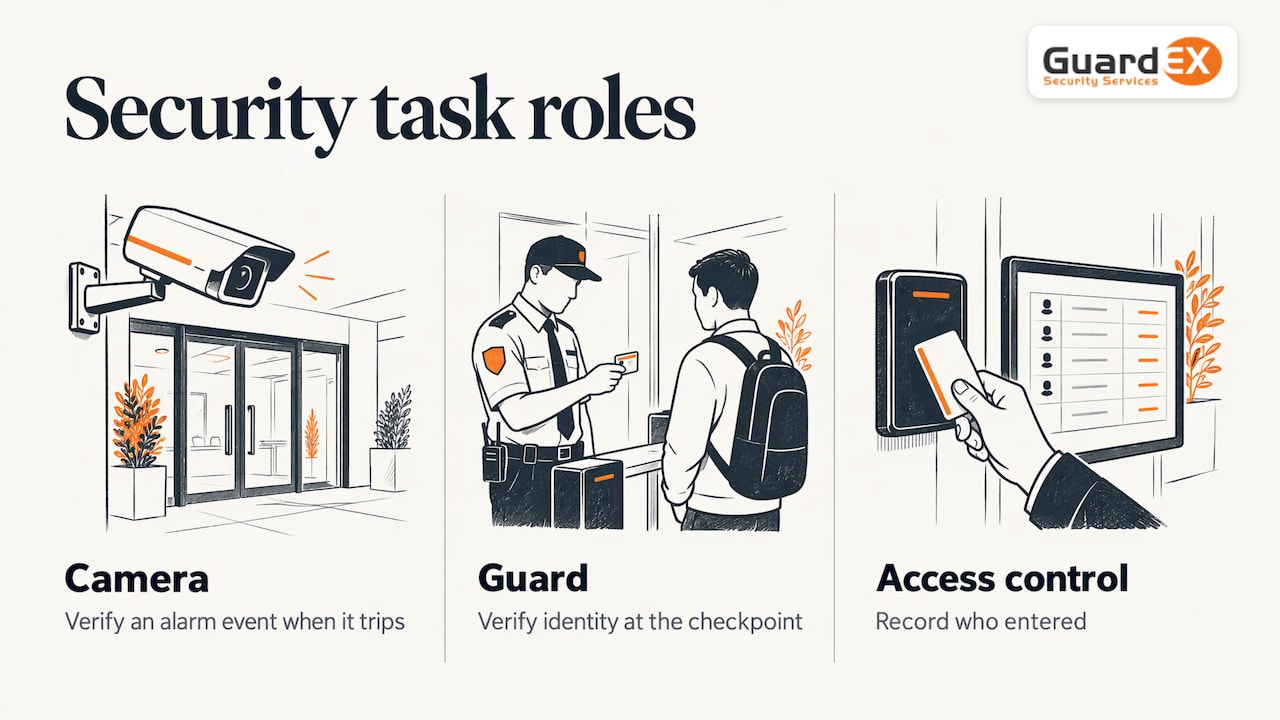
Video helps confirm an event, but constant passive viewing is a poor use of staff. A DOJ school-security guide cites Sandia National Laboratories experiments showing that after about 20 minutes of watching monitors, attention drops well below acceptable levels. Its practical takeaway is to have a security person verify entry requests at a locked door instead of watching hallways.
That is an argument for pairing technology with defined tasks: a camera view pulled up when an alarm trips, a guard at the checkpoint where identity matters, and access control that records who entered. Our piece on video analytics for security explains how analytics can narrow what someone needs to review.
For schools, the same DOJ guide suggests alarm systems that let staff assess a fire alarm and cancel it if false before it becomes audible, plus covers over pull stations that sound locally. Check fire-alarm changes with your local fire official and your fire alarm contractor, as fire systems follow their own codes.
What New Jersey requires, and what it does not
There is no single set of false alarm rules you can apply across the state. In New Jersey, alarm registration, fees and penalties are handled by municipal ordinance, so your obligations depend on the town where the property sits.
Two examples show how much they differ:
- Warren Township’s Chapter 3A on emergency alarm systems requires alarm devices to be registered with the police department, and it sets a fine of $500 to $1,500 on top of other penalties when no designated party arrives within 30 minutes of a false alarm notification.
- Newark amended its burglar and robbery alarm chapter in 2020, adding registration fees for commercial and residential properties and penalties for continuing false alarms.
These are two ordinances, not a statewide rule. Ordinances get amended, so read your town’s current code on its municipal website or ask the police department’s records or alarm unit directly. If you operate in several towns, keep a simple table of each one’s registration requirement, fine schedule and keyholder response time.
The Warren example has a direct operational lesson: a keyholder who cannot reach the site in time can cost more than the false alarm itself. That is worth checking against your own call list. If you are unsure how an ordinance applies to your property, ask the municipality or an attorney. Nothing in this article guarantees compliance or any insurance outcome.
Elsewhere in the country, cities are moving toward verification requirements. In March 2025, Austin, Texas adopted a resolution asking its city manager to recommend code changes that would require threat verification before monitoring services call 9-1-1. It is useful context for where policy is heading, not a New Jersey requirement.
How to tell whether it is working
Percentages can mislead. A research report for the Security Industry Alarm Coalition cautions that a site can be 98 percent false and still have halved its raw dispatches. It recommends the false alarm factor: false alarms divided by alarm users or permits, tracked over time alongside raw counts.
For a property operator, a workable version is:
- Per site: count police-dispatched false alarms per month and per quarter.
- Per portfolio: divide total false dispatches by the number of alarmed sites.
- Compare: keep one or two similar sites on your old routine for a period, so you can see whether a change helped or the season did.
- Record causes: tag each event as user error, equipment, installation, environment or unknown. A shrinking user-error bucket tells you training is landing.
Review the numbers monthly at first. A few clean months do not prove permanent success, but a trend is enough to decide where to spend next.
Where GuardEX fits
False alarm reduction is a coordination job between people, equipment and response. GuardEX offers armed and unarmed security guards, mobile patrols, remote video monitoring, access control and video surveillance planning and installation, all built into customized, site-specific security plans for New Jersey businesses, schools, warehouses, construction sites and residential communities. As a locally owned company, we stay directly involved with the properties we cover and provide clear reporting so you can see what happened and why.
If you want a second set of eyes on your alarm events, call list and coverage gaps, start with our commercial security services or reach us through securityguardex.com.
For a broader view of how coverage, technology and procedures fit together, our business security plan fields are a useful starting template, and the commercial security buyer’s guide covers how to compare coverage options.
FAQ
What causes most false alarms at businesses?
User error is the leading cause. Bellevue’s guide attributes more than 80 percent of false alarms to it, including wrong codes, doors left unlatched and untrained staff or visitors. Equipment and installation problems account for much of the rest.
Should I call 911 to cancel an accidental alarm?
Call your alarm company first. Bellevue’s guide advises against calling 911 to cancel an activation and says to contact the alarm company instead, which can notify dispatch. Follow your municipality’s instructions as well, since procedures vary by town.
Does New Jersey have a statewide false alarm fine?
The examples we found are municipal ordinances, such as those in Warren Township and Newark, with their own registration and penalty rules. Check the code for the town where your property is located, or ask its police department.
What is the difference between ECV and cross-zoning?
Enhanced Call Verification means the monitoring operator tries two contacts before asking for dispatch. Cross-zoning means two sensors must both trip before the alarm signals. One confirms by people, the other by equipment design.
Sources
- Bellevue, WA: False Alarm Prevention Tips
- U.S. DOJ COPS Office: False Burglar Alarms, 2nd Edition
- City of Walla Walla: Alarm Systems
- Orange County Sheriff’s Office: False Alarm Prevention for Commercial Establishments
- NESA: False Alarm Reduction
- FARA and NESA: Guide to Alarm Equipment
- U.S. DOJ OJP: Security Technologies in U.S. Schools
- Township of Warren, NJ: Chapter 3A Emergency Alarm Systems
- City of Newark: Ordinance amending Burglar and Robbery Alarms
- City of Austin: March 2025 resolution on alarm response
- SIAC: Assessment of False Alarm Estimates (2010)