

In this article
A glass break sensor and a motion sensor do different jobs, so for most commercial properties the answer is not one or the other. A glass break sensor reacts to the sound or shock of glazing being broken, which is the moment of entry. A motion sensor reacts to a person moving through a room, which is a moment after entry. Which one carries more weight depends on how much glass your building has, who is inside and when, and what happens after an alarm sounds. We plan site-specific security for New Jersey properties, and the same logic holds whether the site is a warehouse office, a school wing or a storefront: decide where you want to detect an intruder first, then pick the device that fits that spot.
Key Takeaways
- Glass break sensors protect the perimeter (the glass itself). Motion sensors protect the interior (the room). They answer different questions.
- Each has known false-alarm causes. Drapes, shutters and room size affect glass break units. Heaters, sunlight and animals affect motion units.
- Federal security guidance says no single sensor type reliably detects every intruder with an acceptably low false-alarm rate, so overlapping coverage is the standard approach.
- A sensor only reports an event. Someone still has to verify it and respond, which is why many sites pair sensors with video, monitoring, patrols or guards.
How glass break sensors work
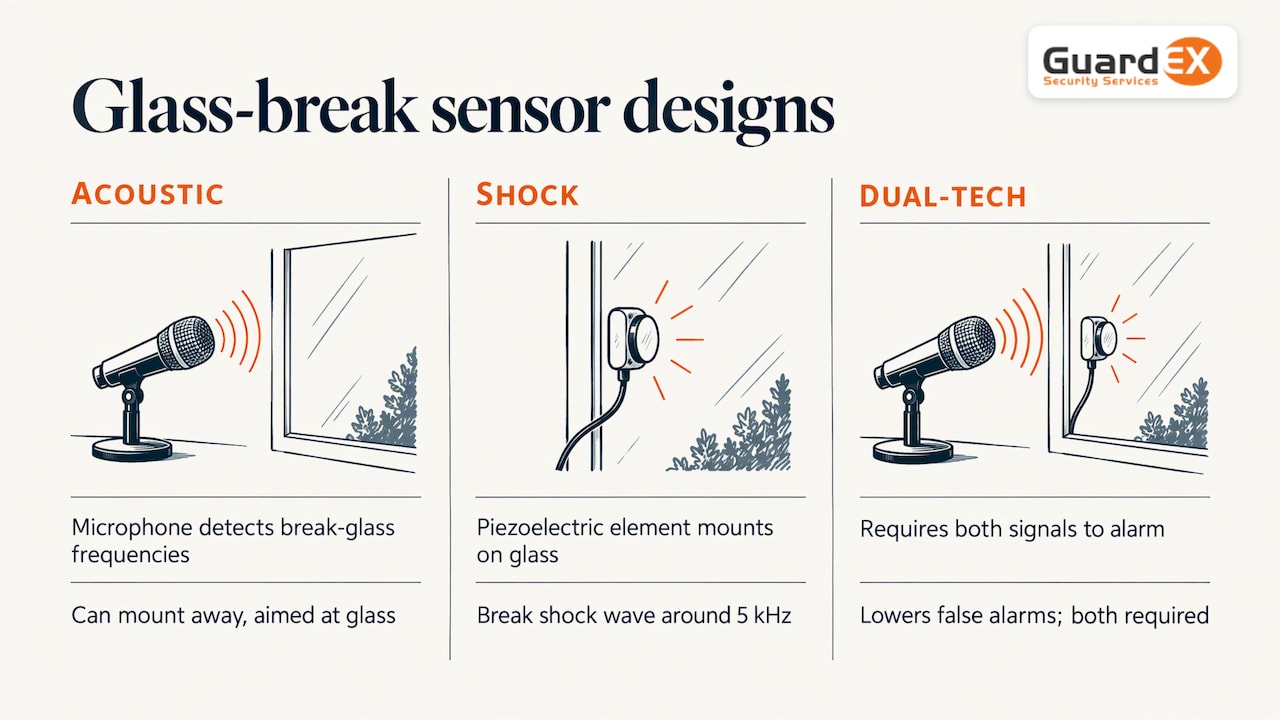
There are two main designs, and the difference matters when you are choosing for a particular window.
Acoustic sensors use a microphone to listen for the frequencies that match breaking glass. According to a U.S. Department of Justice perimeter sensor handbook, they match the sound pattern of a break rather than any loud noise. The USDA Forest Service Physical Security Toolbox adds that these sensors respond to specific frequencies to limit false alarms from ordinary banging, and that they can be mounted away from the glass and pointed at it.
Shock sensors use a piezoelectric element mounted on the glass. They sense the shock wave a break produces, which the same handbook puts at around 5 kHz.
Dual-technology units require both signals before they alarm. That cuts false alarms, at the cost of needing both conditions to be met.
One detail that surprises many property managers: coverage is measured in glass, not floor space. The handbook and the FARA-NESA Guide to Alarm Equipment both note that one glass break sensor typically covers no more than about 100 square feet of glass surface. A long curtain-wall lobby or a row of storefront panes may need several units.
How motion sensors work
Motion sensors are interior protection. They watch an area, not an opening, so they detect movement no matter how the person got in.
Passive infrared (PIR) is the common type. As the Department of Energy’s testing module explains, a PIR sensor measures changes in received infrared energy. The USDA volumetric-motion page describes how a lens divides the room into detection “fingers” and notes the sensor is most effective when a person moves across the pattern rather than straight toward it.
Microwave sensors transmit a signal and detect the Doppler shift when something moving reflects it. They are most sensitive to movement directly toward or away from the unit, which is the opposite of PIR.
Dual-technology motion sensors combine the two and require both to trigger. USDA guidance notes this lowers the false-alarm rate but slightly reduces the probability of detection.
Coverage is area-based. A university course on detectors, HSM University’s LVT-230 lesson, describes PIR units typically mounted 7 to 9 feet high with a fan-shaped pattern roughly 40 feet long and wide.
Side by side
| Glass break sensor | Motion sensor | |
|---|---|---|
| What it protects | Glazing: windows, storefronts, sliding doors | A room, corridor or open floor area |
| What it detects | Sound or shock of glass breaking | Heat movement (PIR) or Doppler shift (microwave) |
| When it alarms | At the moment of entry | After the person is inside the zone |
| Works with people present | Yes, since it ignores movement | Usually only when the area is empty and armed |
| Typical coverage | Up to about 100 sq ft of glass | A fan pattern around 40 ft long and wide |
| Common false-alarm causes | Room acoustics, other sharp noises | Heaters, sunlight, airflow, animals, insects |
The row about people present is the practical one. Perimeter sensors can stay armed while staff work in the building. Interior motion sensors generally cannot, because staff will trip them. HSM University’s example design puts glass break detectors on ground-floor windows and motion detectors in corridors that are armed only after the cleaners leave.
Where each one goes wrong
Both devices work well when installed for the space and poorly when they are not. Here are the documented problem areas.
Glass break sensors
- Soft rooms. The DOJ handbook says carpeted rooms with draperies absorb vibration and can make detection unreliable. Adding shutters, blinds, drapes or rugs after the system was tuned can also cause problems.
- Cracked glass. The same handbook advises checking windows for cracks and replacing them before installation, so the glass produces a proper frequency signature. If your facility team is already scheduling interior window cleaning costs and routines, that visit is a good moment to note any damaged panes.
- Glazing type. The FARA-NESA guide says shock sensors should avoid toughened, wired or laminated glass. The USDA toolbox says that if you protect glazing other than ordinary glass, the sensor must be verified to work with that material.
- Method of entry. The FARA-NESA guide notes acoustic units may fail to detect a pane being removed or cut with a thermal knife. A window that is opened rather than broken will not trigger a glass break sensor at all, so the DOJ handbook recommends pairing them with contact switches.
- Line of sight and noise. Simple acoustic designs can confuse tableware or bells with breaking glass, and some need a line of sight to the glass.
Motion sensors
- Heat and light. HSM University lists heaters, air outlets and windows with direct sun as places to keep PIR units from facing. The Department of Energy module adds moving air, animals, insects and vibration as nuisance sources.
- Insects on the lens. Spiders and insects are a common cause of PIR false alarms, particularly in warehouses and storage rooms.
- Animals. Pet-immune detectors ignore animals below a set weight only if the animal cannot climb above the floor zone. Stray cats in a loading area are a realistic example.
- Signal leaving the room. The NIST guide to commercial intrusion alarms warns that microwave energy penetrates many materials. It recommends keeping the detection field within a single room, because energy escaping a building can be set off by pedestrians, vehicles and swinging signs.
That last point answers a common question: do motion sensors work through glass? PIR sensors respond to heat and are generally pointed away from windows to avoid sun and outside movement, while microwave sensors can see through glass and some walls, which is why placement and containment matter.
Why one sensor type is rarely enough
The DOJ handbook states the planning principle plainly: no single sensor can reliably detect all intruders with an acceptably low false-alarm rate. Defeat potential is reduced by overlapping coverage, using multiple units of one type, more than one type, or both. It also recommends adding a volumetric motion detector inside the protected area, positioned to look toward the window of concern.
HSM University frames this as layers. Perimeter devices such as contacts and glass break detectors catch an intruder at the boundary. Motion detection covers areas rather than openings and acts as backup for anything the perimeter missed.
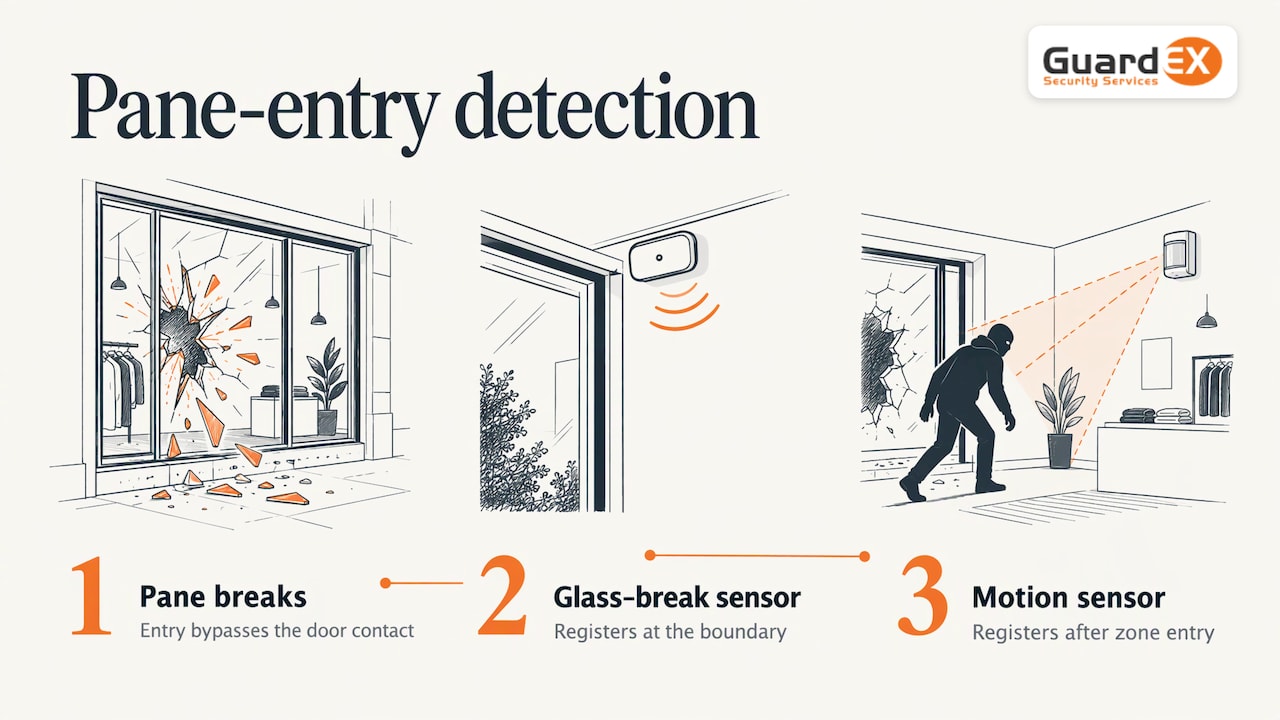
A break-in that skips the door shows why. Someone who shatters a sliding door or storefront pane and climbs through never opens a door contact. Only a glass break sensor or an interior motion sensor will register it. The glass break sensor does so at entry. The motion sensor does so only once the person enters its zone.
Choosing by property type
There is no single correct layout, but these starting points follow the evidence above. Treat them as general guidance, not a New Jersey requirement. Local ordinances, your insurer and your alarm provider may set their own conditions.
Storefronts and glass-heavy lobbies
Glass break coverage matters most here because the glass is the point of entry. Count the square footage of glazing, because one sensor covers about 100 square feet at most. Add interior motion detection for the sales floor or lobby once the space is closed.
Warehouses and distribution centers
Most of the risk is at doors, docks and fenced yards, with fewer windows. Motion sensors work in office areas and enclosed storage, but large open racking, forklift traffic, vibration and insects make false alarms a planning issue. Our guide to layered security for NJ distribution centers shows how detection fits with the rest of the plan, and our piece on commercial door security covers the entry points that glass break sensors do not.
Schools and offices
Occupied hours and empty hours need different settings. Perimeter sensors can protect ground-floor glazing while staff and students are present, and interior motion detection can be armed after the building is cleared. Check the cleaning schedule, because late cleaners are a classic source of avoidable alarms.
Construction sites and open yards
There is often no finished glazing, and no enclosed room for a motion sensor to watch. Outdoor detection is a different problem, and the better fit is usually video, lighting and patrols. See our notes on perimeter security lighting and securing a business perimeter.
Gated and residential communities
Clubhouses, leasing offices and maintenance buildings have glass and interior rooms. The bigger exposure is often the community’s entrances, which is a job for gated community security and access control.
Installation checks that prevent false alarms
Most nuisance alarms come from placement, not from the device. Use this checklist when reviewing a proposed layout.
- Map the glass. List each window, door light and storefront pane, with its approximate area and glazing type.
- Match the sensor to the glazing. Confirm any laminated, wired or toughened glass is compatible with the chosen sensor type.
- Check the room. Per the Johnson Controls-published guidance on glass break placement, small rooms under 10 by 10 feet, heavy lined drapes and closed shutters are trouble spots. The DOJ handbook says the same about soft furnishings.
- Keep sensors clear of noise. Compressors, HVAC units and machinery produce sound that can confuse acoustic units, and the DOJ handbook also lists RF interference and sharp impact noises.
- Place motion units away from heat and sun. Avoid facing heaters, vents and sunlit windows, and mount at the height the manufacturer specifies.
- Re-test after changes. New blinds, rugs, racking or furniture alter the room. The DOJ handbook says changes made after tuning can leave detection inadequate.
- Define the response. Decide who receives the alarm, who verifies it and who goes to the property.
Step 7 is where sensor decisions meet staffing. A sensor tells you something happened. It does not tell you whether it was an intruder, a cat or a floor buffer.
What happens after the alarm
A triggered sensor creates a decision: dispatch, verify or ignore. Property managers often find that the cost of a poorly verified alarm is time, since staff or responders spend it on events that turn out to be nothing. Layering detection with a verification method helps.
We provide several options for that part of the plan:
- Video security systems let you see what triggered an alarm. We plan and install surveillance systems for New Jersey properties.
- Remote security monitoring puts a monitoring operator behind cameras so an event can be assessed.
- Mobile patrol offers a visit to the site, with checkpoints and reporting.
- Security guards, armed or unarmed, provide an on-site presence where the risk justifies it.
- Access control systems manage who enters at doors and gates, which reduces the number of unknown people inside when interior sensors are armed.
Planning your layers with GuardEX
If you are comparing glass break and motion detection for a building, the useful starting point is a site walk, not a product list. We build customized, site-specific security plans around each property’s risks and operating needs, covering guards, patrols, remote monitoring, video and access control for businesses, schools, warehouses, construction sites and residential communities. Our offer pages describe each service, and our perimeter security page is a good place to see how the layers fit together.
To discuss a property, start from our GuardEX site. No security plan can promise to prevent crime or guarantee a particular insurance or compliance outcome, but a plan built on overlapping detection and a clear response gives your team the best information to act on.
FAQ
Which is better, a glass break sensor or a motion sensor?
Neither is better across the board. Glass break sensors alarm at the moment glass is broken, and motion sensors alarm when someone moves through a protected area. Most plans use both, with glass break or contacts on the perimeter and motion detection inside.
Can a motion sensor replace a glass break sensor?
Not fully. A motion sensor only alarms once an intruder is in its zone, and it usually has to be disarmed while people are inside. A glass break sensor can stay armed with staff present and responds at entry.
Do PIR motion sensors work through glass?
PIR sensors detect infrared heat changes and are typically aimed away from windows because sunlight and outside heat sources cause false alarms. Microwave sensors transmit energy that can pass through many materials, so NIST advises containing the detection field within one room.
Why do glass break sensors give false alarms?
Common causes include sounds that resemble breaking glass, such as dishes or bells, and rooms where acoustics are poorly matched to the sensor. Proper placement, correct sensitivity and re-testing after furnishings change help reduce them.
Sources
- Perimeter Security Sensor Technologies Handbook (U.S. Department of Justice)
- Physical Security Toolbox: Boundary-Penetration Sensors (USDA Forest Service)
- Physical Security Toolbox: Volumetric-Motion Sensors (USDA Forest Service)
- Module 6: Performance Testing of Interior Detection Systems (U.S. Department of Energy)
- Selection and Application Guide to Commercial Intrusion Alarm Systems (NIST SP 480-14)
- Guide to Alarm Equipment (FARA-NESA)
- Detectors: Contacts, Motion, Glass-Break and More (HSM University)