

In this article
- Key Takeaways
- What a security service contract actually does
- Start with the site, not the paper
- The sections every contract should contain
- Reporting and incident response
- Fees, overtime and billing
- Insurance, liability and indemnification
- What New Jersey adds to the picture
- Service levels and remedies for missed coverage
- Termination, renewal and transition
- Matching the contract to the property type
- Reviewing a draft or template before you sign
- Working with a local provider
- FAQ
- Sources
- Recommended
A security service contract is the agreement that turns a security plan into coverage you can hold someone to. It names the property, the posts, the hours, the duties, the price and who carries which risk. The strongest contracts are written around a site assessment, not around a generic template, which is why we build coverage plans from each property’s own risks and operational needs. This guide walks through what a New Jersey property manager or business owner should define before signing.
Key Takeaways
- A contract is only as useful as its scope: list every post, patrol, shift and duty, and attach post orders instead of describing them loosely.
- Reporting, supervision and remedies for a missed post belong in writing, with deadlines and a stated consequence.
- New Jersey regulates security companies and officers under the Security Officer Registration Act, and armed officers carry additional credentials. Ask for proof of both.
- Fees, overtime, holiday rates, insurance, indemnity and exit terms should be stated by number and notice period, not left to “standard practice.”
- A template is a starting point. Adapt it to the site and have your attorney review the final draft.
What a security service contract actually does
In plain terms, it is a commercial agreement between a property owner (the client) and a security provider. It defines the protective services, staffing, duties, price and allocation of risk, as one industry guide describes it. For a warehouse, a school, a construction site or an HOA community, that means the document answers four practical questions:
- Who is on site, where and when?
- What are they supposed to do, and what should they not do?
- How will you know the work was done?
- What happens when something goes wrong, or when the relationship ends?
If any of those four is vague, the gap tends to surface at the worst moment: after an incident, during a billing dispute or at renewal.
Start with the site, not the paper
Before a provider writes a proposal, you need to know what you are protecting and from what. Buildings magazine’s guidance on security contracts recommends assessing site risks first, then documenting scope, duration, liability, insurance, payment, uniforms, equipment, posts, hours, use-of-force policy and rate structures. The order matters. A contract written before the assessment usually buys coverage based on assumptions.
For a New Jersey site, the assessment usually looks at:
- Entry points and traffic: gates, dock doors, guard booths, visitor and vendor flow.
- Time of exposure: overnight vacancy, shift changes, weekends, school breaks, construction downtime.
- Loss patterns: theft, vandalism, trespassing, tailgating, after-hours access.
- Existing technology: cameras, alarms, card readers and who watches them.
Our security site assessment guide for NJ properties covers this step in more detail. The result feeds directly into the scope section of your agreement.
The sections every contract should contain
Parties, premises and term
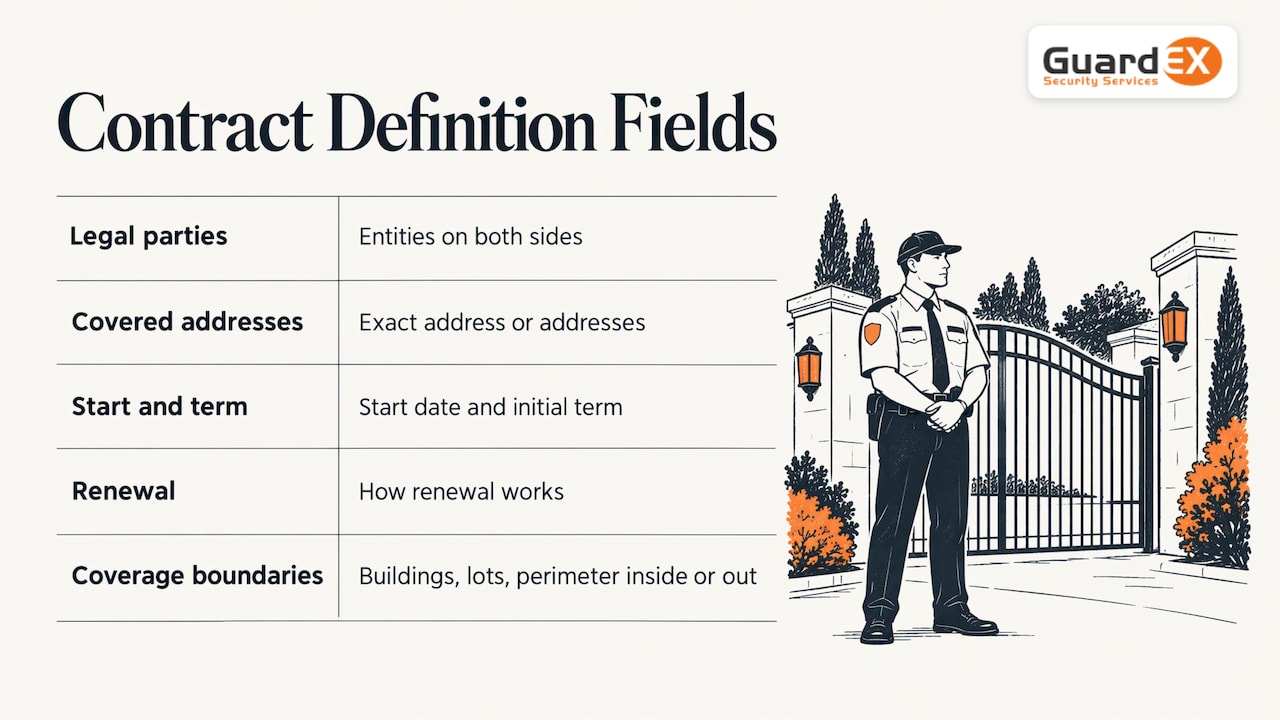
Name the legal entities on both sides, the exact address or addresses covered, the start date, the initial term and how renewal works. If the property has multiple buildings, lots or a gated perimeter, say which are inside the coverage and which are not.
Posts, patrols and schedule
This is the section that does the most work. List each post by location and hours. For each patrol, state the route, the frequency and how a visit is verified. State whether officers are armed or unarmed. One published checklist recommends defining each post, shift, day and holiday, and attaching the scope of work and post orders to the agreement, along with break relief and replacement for absent officers.
Here is how the same property might be written two ways:
| Vague | Specific |
|---|---|
| “Provide security at the warehouse.” | “One unarmed officer at the main gate booth, Monday to Friday, 6 p.m. to 6 a.m.; a second officer on weekends.” |
| “Patrol the property regularly.” | “Four exterior patrols per night along the attached route map, each verified by checkpoint scan.” |
| “Officer will respond to incidents.” | “Officer follows the attached escalation procedure and notifies the site manager by phone within the timeframe in the post orders.” |
The specific column gives you something to measure. The vague column gives you an argument.
Post orders
Post orders are the written instructions for what an officer does at a specific assignment: who to admit, how to log deliveries, when to call the manager, what to do about a trespasser, where the checkpoints are. Attach them to the contract so they are part of the agreement. Update them when the site changes, such as a new tenant, a new gate or a construction phase.
Staffing, qualifications and training
State the minimum qualifications for officers assigned to your site, how the provider replaces someone you want removed, and what site-specific training officers receive before their first shift. A sample guard service agreement published by a religious institution’s handbook shows one common allocation: the provider selects guards and bears payroll costs, the location may request an assignment or a removal, and supervision stays with the provider. That is a California document, but the division of responsibility is a useful model for any property.
Supervision
Ask who supervises officers and how often. A California Highway Patrol standard agreement shows how specific a public buyer can be: it requires supervision throughout each shift and sets, for assignments without a site supervisor, an approximate ratio of one supervisor to 20 guards and one unannounced daily visit at each staffed location. Your site will not need the same numbers, but the principle holds. Write down who checks the officer, how often and how that check is documented.
Reporting and incident response
If you cannot see what happened on a shift, you are paying for coverage on trust. The contract should state:
- Which reports are required: daily activity reports, incident reports, patrol logs.
- The format and the delivery deadline for each.
- How quickly serious incidents are reported to you, and by what channel.
- How long records are retained and how you get access to them.
The contract checklist cited above recommends specifying daily activity and incident reports, patrol records, format, delivery time, retention and client access. Also define when officers contact police, fire or EMS, and what they do before responders arrive. Use-of-force and law enforcement procedures should be written out, not implied.
Clear reporting is one of the ways we hold ourselves accountable on our own assignments, alongside technology, on-site officer training and ongoing support.
Fees, overtime and billing
Money terms should be as concrete as the duty terms. Specify:
- Bill rates by officer type (unarmed, armed, supervisor).
- Overtime and holiday rates, and what triggers them.
- How time is recorded and how invoices are issued and disputed.
- When and how rates can change during the term.
- Who supplies equipment such as radios, vehicles, patrol scanners and uniforms.
A frequent surprise is the holiday and coverage-extension rate: a storm, a special event or a sudden request to hold a post longer. Decide the rate before it happens. If your property sometimes needs one-time or emergency coverage, put the request process and rate basis in the contract so it can be approved quickly.
Insurance, liability and indemnification
Ask for certificates of insurance that match the assignment, including whether the policy covers armed or unarmed officers, and whether your organization is named as an additional insured. Indemnification clauses say which party covers which losses; these are legal terms with real financial consequences. This is the part of the agreement where your attorney, and where relevant your insurance broker, should read every line. No contract can guarantee a particular insurance outcome or prevent every loss, so the goal is clarity about who is responsible for what.
What New Jersey adds to the picture
General contract advice applies anywhere. Licensing rules do not. Ordinary commercial guard contracts are generally governed by state contract law and the state’s private security licensing rules rather than one federal statute, according to the same industry guide. Other states have different systems, and some have changed rules recently, so do not apply another state’s sample language to a New Jersey property without checking it.
In New Jersey, the New Jersey State Police Private Detective Unit administers the Security Officer Registration Act (SORA). The State Police’s SORA rules implement the Act and provide for licensing of security officer companies and registration and certification of security officers. The definition of a security officer company includes a watch, guard or patrol agency.
For armed assignments, the State Police armed security officer FAQ states that an armed officer needs the SORA armed certification and a valid permit to carry a handgun, that the certification alone does not authorize carrying a firearm, and that armed officers renew annually and attend an 8-hour block of instruction by a licensed SORA instructor each year. That document is dated 2019, so confirm current requirements with the State Police before you rely on specifics.
What this means for your contract:
- Require the provider to state its New Jersey company license and to keep every assigned officer properly registered for the duration of the agreement.
- For armed posts, require armed credentials for each officer assigned, and say that the provider must replace anyone whose credentials lapse.
- Require the provider to notify you if a license or registration status changes.
These are contract terms that follow from the state’s system. They are not legal advice, and your attorney should confirm how they apply to your situation.
Service levels and remedies for missed coverage
A contract should say what happens if an officer does not show up, leaves early or skips a patrol. Useful provisions include a missed-post notice, replacement within a stated period, a billing credit for hours not staffed, a written corrective plan after repeated issues and termination rights after repeated failures. The checklist referenced earlier lists missed-post notices and billing credits among its recommendations. The same discipline of measurable service levels in contracts applies to any recurring on-site service, because a standard you cannot measure is a standard you cannot enforce.
Termination, renewal and transition
Check three things:
- Termination for cause: the sample agreement mentioned above allows immediate termination for material breach, which is a common structure.
- Termination for convenience: the same document lets either party end the agreement on 30 days’ written notice. Your own notice period may differ, but it should be explicit.
- Renewal: automatic renewals can lock you in. Note the notice window to cancel and put it in your calendar.
Also require a handover: keys, access cards, post orders, logs and reports return to you when the agreement ends, and the provider cooperates with the next team for a defined period.
Matching the contract to the property type
The same framework flexes by site:
- Warehouses and distribution centers: gate booth hours, truck check-in logs, dock supervision and after-hours patrols. See our layered plan for distribution center security.
- Manufacturing plants: shift-change coverage, contractor access and perimeter checks. Our page on guards for manufacturing plants outlines the issues.
- Construction sites: after-hours coverage, equipment and material protection, delivery access and changing site layouts. Read about securing construction sites.
- Shopping centers and retail: visibility, parking areas, tenant coordination. See our shopping center security planning guide.
- Residential and gated communities: gate procedures, visitor logs, resident communication and patrol schedules, often paired with access control.
Technology belongs in the contract too, when it is part of the plan. If officers rely on cameras, remote monitoring or card readers, say who owns, maintains and monitors the equipment, and what happens during an outage.
Reviewing a draft or template before you sign
Templates are useful for seeing what topics a contract covers. They are not a substitute for fitting the agreement to your site. One template publisher states that its templates are general information that may contain errors or unlawful provisions and should not be relied on as-is. Treat any template that way.
A practical review sequence:
- Compare the draft with the scope you sent out. Every post, patrol and duty in your request should appear in the agreement.
- Verify the company license and officer registration with the New Jersey State Police.
- Collect insurance certificates that match the assignment, including armed coverage where relevant.
- Ask for sample reports so you know what you will receive.
- Confirm who supervises the site and who answers the phone after hours.
- Have your attorney review the final draft, particularly indemnity, liability and termination.
Working with a local provider
We are a boutique security company in New Jersey, and the ownership is local and directly involved. We offer armed and unarmed security guards, mobile patrol, remote security monitoring, video security systems and access control. We start from a customized, site-specific security plan, and that plan is what the contract’s scope, posts and reporting sections are built from.
If you are preparing to bring security coverage to a property, send us the address, the hours you need covered and the concerns you have. We will talk through what coverage fits and put the scope in writing. You can start from our main site.
FAQ
What should a security service contract include?
At minimum: the parties, the premises, each post with its hours, patrol routes, whether officers are armed, post orders, supervision, reporting deadlines, rates, insurance, indemnity, termination and handover terms. The more of these you state in numbers and times, the easier the contract is to manage.
Do security guards in New Jersey need to be licensed or registered?
New Jersey regulates security officer companies and security officers through the Security Officer Registration Act, administered by the State Police. Armed officers need additional certification and a permit to carry a handgun. Confirm current requirements with the State Police Private Detective Unit, and ask your provider for proof.
Can I use a free template for a security guard contract?
You can use one to see which topics to cover, but adapt it to your site and New Jersey rules. Template publishers themselves caution that templates may contain unsuitable provisions. Have an attorney review the final agreement before you sign.
How long should a security contract last?
There is no single standard. Many properties pair an initial term with a renewal clause and a written notice period for ending the agreement. Whatever you choose, make the renewal and cancellation notice dates explicit so they do not pass unnoticed.
Sources
- Security guard contract: what a security services agreement covers
- Four Considerations for Security Contracts, Buildings
- Security Guard Contract Checklist: Review Before You Sign
- Security Guard Service Agreement (sample, revised 2020)
- California Highway Patrol Standard Agreement 16C029005
- New Jersey State Police: Security Officer Registration Act rules, N.J.A.C. 13:55A
- New Jersey State Police Private Detective Unit: Armed Security Officer FAQ
- Security guard contract template, Juro
- Property Maintenance Cleaning Contract Explained